A Better Way.
Homily for the Solemnity of All Saints
November 1, 2026
There is an old Chinese tale about a woman whose only son died. In her grief, she went to the holy man and said, “What prayers, what magical incantations do you have to bring my son back to life?”
Instead of sending her away or reasoning with her, he said to her, “Fetch me a mustard seed from a home that has never known sorrow. We will use it to drive the sorrow out of your life.” The woman went off at once in search of that magical mustard seed.
She came first to a splendid mansion, knocked at the door, and said, “I am looking for a home that has never known sorrow. Is this such a place? It is very important to me.”
They told her, “You certainly come to the wrong place,” and began to describe all the tragic things that recently had befallen them.
The woman said to herself, “Who is better able to help these poor, unfortunate people than I, who have had misfortune of my own?” She stayed to comfort them, then went on in search of a home that had never known sorrow. But wherever she turned, in hovels and in other places, she found one tale after another of sadness and misfortune. She became so involved in ministering to other people’s grief that ultimately she forgot about her quest for the magical mustard seed, never realizing that it had, in fact, driven the sorrow out of her life.
---------------------------------------
Shortly after we learned that Pope Leo had been diagnosed with lung cancer, I listened to a commentary about how this experience would change him. From that point on, whenever he spoke about fear of dying, or the need to trust in the Lord, it would not be an academic approach, or something he read about, or something he learned in a theology class. It would be something real, something Pope Leo understood from the inside. And from that day on, he could be more authentic when it came to ministering to the sick and dying.
---------------------------------------
The things Jesus lists as making people blessed, are probably not at the top of the list of what we would naturally look for in life. Who wants to be poor, to experience crushing sorrow, to be socially meek, or to endure misunderstanding and persecution? Who wants to be like the Chinese woman, who lost her only son?
When I ask myself that question, I discover an astounding answer. Evidently, God does! Like the Chinese woman, God lost his only Son! Consider the following passage from Paul’s letter to the Romans:
If God is for us, who can be against us? Is it possible that he who did not spare his own Son but handed him over for the sake of us all will not grant us all things besides? Who
shall bring a charge against God’s chosen ones? God, who justifies? Who shall condemn them? Christ Jesus, who died or rather was raised up, who is at the right hand of God and who intercedes for us? Who will separate us from the love of Christ? (Romans 8:31-35)
Or consider the following from Paul’s letter to the Philippians:
Though he was in the form of God, [Jesus] did not deem equality with God something to be grasped at. Rather, he emptied himself and took the form of a slave, being born in the likeness of men. He was known to be of human estate, and it was thus that he humbled himself, obediently accepting even death, death on a cross! (Philippians 2:6-8)
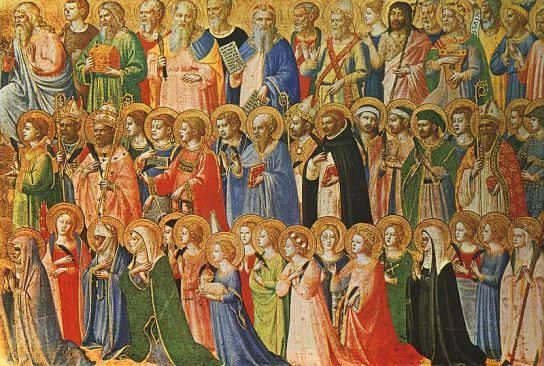
Today, we honor the saints, the heroes of our faith, those who left us examples of various ways of imitating Jesus Christ. They accepted the way of humble service and lived in the spirit of the Beatitudes. They brought the healing power of love to human brokenness, reaching out to the sorrowing, the meek of the earth, those being abused and persecuted, those deprived of justice and peace—and in so doing, showed how we can be a source of hope and blessing for our world. Since we can so easily stray, saints are needed in every age to remind the world that Jesus taught a better way.
You might also like
Father's Homilies